Tina Top: Sewing Instructions
As with all knits and stretch fabrics, a serger/overlock will make your life easier. If you don’t have one, don’t despair. You don’t really need one. All serged seams on Toni can also be sewn with a short, narrow zigzag stitch (~2 mm wide) on a standard sewing machine.
For the topstitching steps, a coverstitch works best, but if you don’t have a coverstitch, a twin needle will also give good results. Of course, you can also use a zigzag stitch.
Step 0: Prepare the fabric
Cut out the parts including seam allowance and transfer markings and notches to the fabric. Note that there are two different kinds of notches. You probably want to use a different notch shape or a different pen/chalk color for ×-notches.
If present, trim the highlighted triangle from the seam allowance of both front parts. It’s only present on the pattern for technical reasons and would be in the way when finishing the diagonal edge.
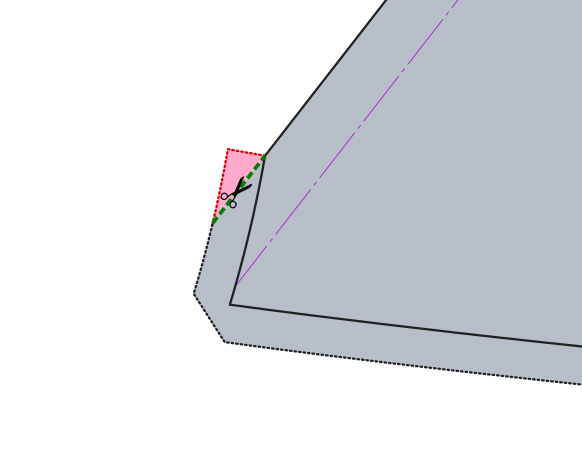
Step 1: Prepare the front part
If your pattern needs to do a larger front bust adjustment, your design may include a bust dart at the side seam of the front part. Sewing the dart is optional, the end of this paragraph contains some alternatives.
If your pattern contains no dart, which will be the case for most people, skip to step 2.
Sewing the dart
If the pattern was drafted with darts, fold your front part along the center line of the dart.
Sew using an elastic stitch along the dart line from the side seam towards the bust. Near the dart tip, make sure to stitch as parallel to the fold line as possible while still stitching over the folded edge.
If not using a serger, cut away any unnecessary fabric from the dart and finish raw edges.
Repeat this for both sides.

Alternatives
If you want to skip the dart, you could gather or pleat the fabric instead to match the side seam lengths.
Alternatively, if you want to color block your shirt, you could move the dart to where you put a color seam anyway.
Step 2: Sew the shoulder seams
Match up the fronts and the back part along the edges between the neck and the armholes and matching raw edges.
Sew using an elastic stitch. Repeat for both sides.
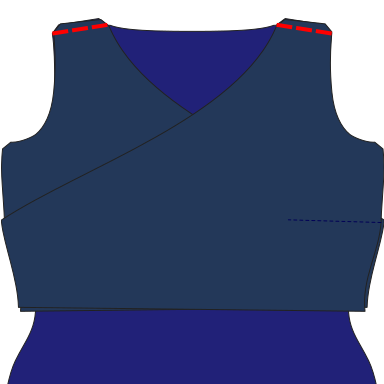
Step 3: Finish the neck and front edge
Unfold the main body piece again. Pin the knit binding piece for the neck on the diagonal front edges and on the back of the neck, matching raw edges. Add more stretch to the binding where it curves, so it stays flat against the neck later.
Adding additional stretch along the front parts can also help prevent gaping, but don’t overdo it, as it could distort the general shape.
Topstitch both parts together. The distance of the stitch to the raw edge is the width of the knit band divided by four. This is not necessarily equal to the standard seam allowance. For example, if your knit band is 6 cm wide, sew 1.5 cm from the edge.
You should have some length of knit binding left over at the end of the diagonal front edges. Leave them as is for now, they will be stitched into the side seam (or waistband, depending on settings) later, to secure them.
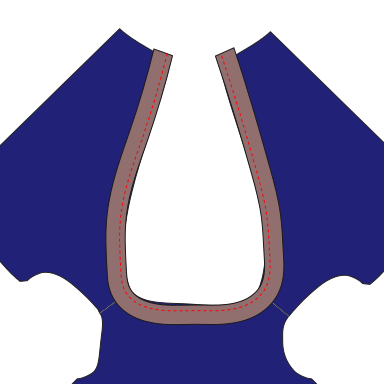
Fold the neck binding upwards and to the inside of the top. This will create a fold at the stitch line you just created, and another one at the original raw edge of the front and back parts.
Topstitch the neck binding in place from the outside.
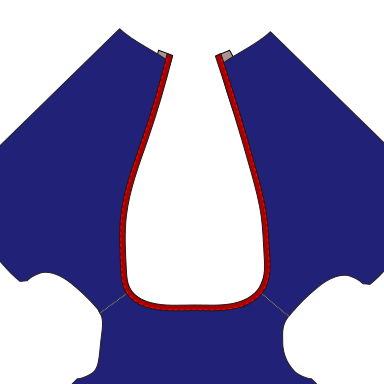
Trim loose fabric on the inside to reduce bulk. The inside edge can be left raw if you’re using knit fabric.
Step 4: Sew the sleeves
If your design doesn’t have a sleeve part, skip to the next step.
If your design has a separate sleeve part, pin the sleeve part to the main body part, , matching notches and raw edges.
The hem of the sleeve points towards the neck opening.
Note that the sleeve part is not perfectly symmetrical. The ×-notch of the sleeve goes to the back part. The round notch attaches to the front part.
Sew with an elastic stitch. Repeat for both sleeves.

Step 5: Join the front parts
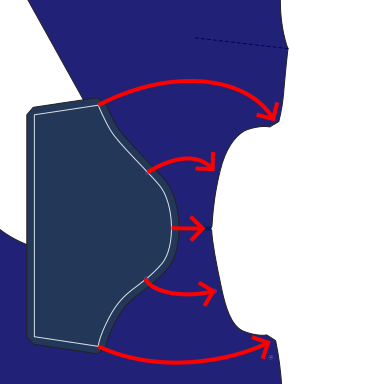
If your design has a front bottom piece, pin or baste it to both bottom edges of the triangle-shaped front parts, , matching notches and raw edges.
If the outer sides of the front pieces have notches, also align and pin or baste them.
The front part that should be later fully visible on the outside goes towards the bottom part.
If your design has a front bottom piece, sew all three parts together along the bottom line while keeping any pins on the side seam in place. Otherwise, just keep them pinned or basted together for the next step.
You can add an elastic band to the seam between the top and bottom front pieces to add some compression there. This is especially useful if the seam is right below the bust, and you want to use the upper portion of the top like a basic bralette.
Step 6: Sew the side seams
With , pin the sides of the front parts to the sides of the back part. If present, also pin the bottoms of the sleeves together.
With the front parts on top, sew using an elastic stitch. Repeat for both sides. Remove any threads used for basting and gathering.
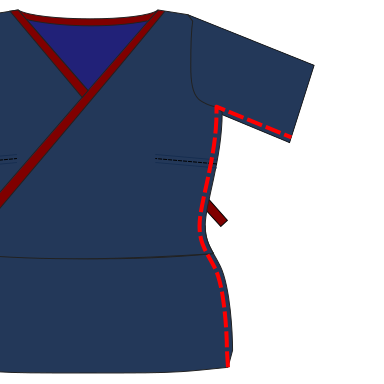
If necessary, trim any remaining loose ends of the knit binding.
Step 7: Create the hem
Using a waistband
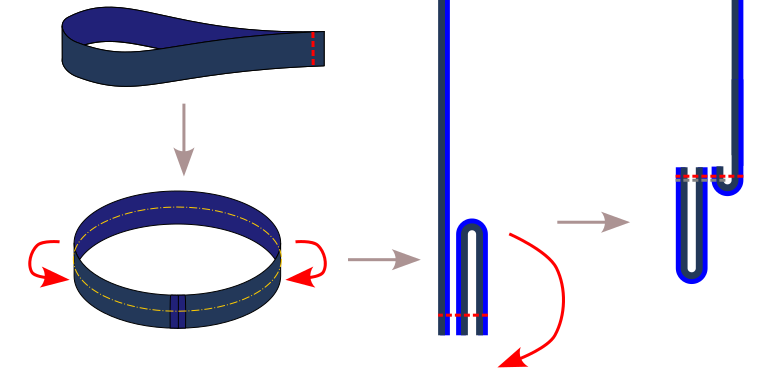
If you’ve chosen to finish the hem with a waistband, sew together the short sides of the waistband, , to create a tube.
Then fold the fabric in half along its length, raw edges together, so the good sides are outside.
With the main body piece turned inside-out, pin the ribbing tube inside the bottom opening, matching raw edges. Mark and align quarters for a consistent stretch. The ribbing is a bit shorter, so stretch it a bit while pinning.
Sew using an elastic stitch.
Fold the hem to the outside.
Optional: Topstitch the seam allowance towards the main body piece to keep it in place.
Simple hem
If you’ve chosen the option without a waistband, fold over the hem allowance to the inside and topstitch in place using an elastic stitch.
Step 8: Finish the armholes
Finish the arm openings the same way you finished the neckline (for sleeveless designs) or the hem (for designs with sleeves).
Step 9: Finishing
You’re done. Time to try it on. If the front parts are too loose, you could hand-stitch them together at the neck opening or add a closure, like a button or a bit of hidden hook and loop tape.